4Front ProAudio VST/VSTi





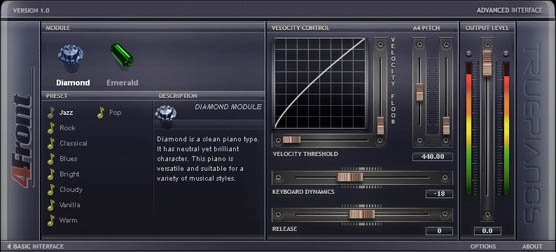
| 4FRONT TruePianos TruePianos is a new virtual piano VSTi based on a combination of physical modeling, synthesis and sampler techniques. Using a combination of the best what these individual technologies have to offer, TruePianos provides great playability by allowing itself to be easily adjusted to the combination of your unique playing style and the specific characteristics of your MIDI keyboard, instead of the other way around. It doesn't attempt to meticulously simulate existing pianos but instead provides realistic and expressive range of piano modules, each with individual dry sounding presets that you 'just play'. |
||
Phim Sahara 2005 ((link)) May 2026In the pantheon of early 2000s action-adventure cinema, Sahara occupies a peculiar and fascinating space. Based on Clive Cussler’s best-selling novel—the eleventh installment in the Dirk Pitt series—the film arrived with the swagger of a potential blockbuster franchise starter. It boasted a charismatic lead, exotic locations, and a plot that wove together Civil War-era history, African political intrigue, and environmental catastrophe. Yet, upon its release in 2005, Sahara became less known for its on-screen heroics than for its off-screen financial shipwreck, ultimately sinking Cussler’s hopes for a recurring big-screen hero. Nevertheless, judged on its own merits as a piece of escapist entertainment, Sahara is a wildly uneven but often endearing relic of a bygone era of studio filmmaking. At its core, Sahara is a throwback to the treasure-hunting adventures of the 1980s, specifically the Indiana Jones and Romancing the Stone models. The plot is gloriously convoluted: deep in the Malian desert, National Underwater and Marine Agency (NUMA) adventurer Dirk Pitt (Matthew McConaughey) and his sidekick Al Giordino (Steve Zahn) discover a secret river leading to a hidden wreck. They believe it to be the Teksas , a Confederate ironclad warship that mysteriously vanished with a cargo of gold coins during the Civil War. Simultaneously, a World Health Organization doctor, Eva Rojas (Penélope Cruz), is investigating a toxic plague spreading down the Niger River. Naturally, the two threads intertwine: the plague is a byproduct of a clandestine waste facility run by a ruthless West African dictator, General Zateb Kazim (Lennie James), who is using the ironclad’s location as a shield. The film’s willingness to embrace this pulpy, anything-goes logic is its greatest strength and its most glaring weakness. It moves at a breakneck pace, rarely pausing for the audience to question how a 19th-century warship ended up in the Sahara—a mystery the film eventually answers with admirable audacity. phim sahara 2005 The film’s primary asset is its cast. Matthew McConaughey, in the midst of his “rom-com” phase, proves a surprisingly capable action lead. He brings a laid-back, sun-bleached charm to Dirk Pitt, a character who is less a rugged soldier than a clever, lucky frat boy who happens to know his history. McConaughey never takes the material too seriously, and that self-awareness is crucial. He is perfectly counterbalanced by Steve Zahn, who delivers a masterclass in comedic sidekickery as Al. Their banter feels genuinely lived-in, providing the film with its most consistently enjoyable moments. Penélope Cruz, while given the thankless role of the “competent professional who needs rescuing,” handles the exposition with grace, and Lennie James chews the sparse desert scenery with glee as the villainous Kazim. The chemistry among the leads elevates the material far beyond what the script deserves. In the pantheon of early 2000s action-adventure cinema, Ultimately, Sahara ’s legacy is defined as much by its budget as by its content. Costing an estimated $160 million (a figure inflated by extensive reshoots and location changes), it became infamous as a box-office bomb, grossing just $119 million worldwide. The ensuing legal battles between Cussler and the studio over script approval and marketing effectively killed any chance of a sequel. Yet, two decades later, the film has found a second life as a cult favorite. In an era dominated by grim, deconstructed superheroes and hyper-serious franchise installments, Sahara ’s unapologetic silliness feels almost refreshing. It is a film that knows exactly what it is: a sun-drenched, two-hour chase for lost gold and a clean water supply, powered by Matthew McConaughey’s biceps and Steve Zahn’s one-liners. Yet, upon its release in 2005, Sahara became Where Sahara stumbles is in its execution of spectacle. Director Breck Eisner has a clear eye for sweeping widescreen compositions, capturing the desolate beauty of the Moroccan and Mauritanian landscapes. However, the action sequences are a mixed bag. A thrilling boat chase through the historic streets of Timbuktu and a climactic battle involving a massive solar-thermal plant are genuinely inventive. Yet, other set pieces—particularly a shootout on the ironclad—suffer from choppy editing and a reliance on CGI that has aged poorly. The film’s biggest sin, however, might be its pacing. After a breezy first hour, the final act becomes bogged down in convoluted exposition and repetitive explosions, losing some of the lighthearted momentum that made the earlier scenes so enjoyable. Sahara is not a great film. It is too long, too expensive-looking for its B-movie soul, and its plot defies logic at every turn. But it is rarely boring. It stands as a fascinating artifact of a time when studios were willing to gamble nine-figure sums on original(ish) action properties based on the sheer star power of a leading man’s smile. As a final send-off for Dirk Pitt on the silver screen, Sahara is less a buried treasure and more a fun, shiny trinket—easily enjoyed on a lazy afternoon, even if it’s not worth its weight in Confederate gold. |
||
| 4FRONT BASS MODULE (VSTi) The bass module is a morph between sample playback and a synthesizer. Original string excitation is sampled, and then sound is modeled. Playing chords will add extra fat rumble, like when playing a real bass guitar. Bass guitar range was artifically extended up and down, so that higher notes and parts can be played as well. |
||
|
4FRONT RHODE MODULE (VSTi)
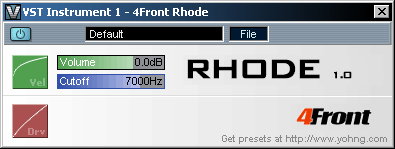
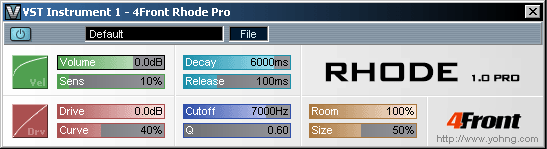
A vintage Rhodes/Wurly typed piano module with gentle overdrive. This module reproduces the classic sound similar to Rhodes/Wurlitzer pianos. Module is not sample based, and the sound is generated on-the-fly, therefore there are no sampling layer switches - vintage rhodes overdrive is smooth, clean and continuous. Difference between Basic (free) and Pro (commercial) modules To get a common idea of what exactly is different, check the screenshots below: Basic version:
As you can see, basic version is generally lacking envelope, sensitivity/drive and room controls, that Pro version has. If you like to get this kind of controlling over 4Front Rhode sound, you may want to get Pro version. MP3 Demos |
||
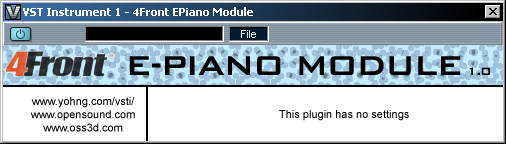
| 4FRONT E-PIANO MODULE (VSTi) E-Piano module with a rich, warm and silky sound. It is quite unique by its character. The module is made with a hybrid technology, which involves sample playback and synthesizing within one case. For its quality, module has reasonable small size. |
||
|
4Front XLimiter (VST/DX)
A gentle and soft brickwall limiter processor. Primary design goals: - Master track brickwall compression - Vocal track compression - Solo track compression A special multistage algorithm provides a very soft transition envelope, thus rapid level changes at extreme Threshold level will not pump or distort as much as with the other processors. The limiter employs best properties of a single band processor, whereas additional techniques are used to provide advantages of "continuous multiband" processing. Usage: With the default settings it will limit the signal at 0dB. This is useful to plug into the master effect bin of a multitrack software. You can lower Threshold value to bring up the volume of the track. If you are limiting a vocal track - you can also set appropriate ceiling value to control the output volume. If you have deessing or disturbing frequencies problem, try using this effect as a vocal or solo processor. In most cases you will not need an additional de-essing, as XLimiter will handle those transients properly. 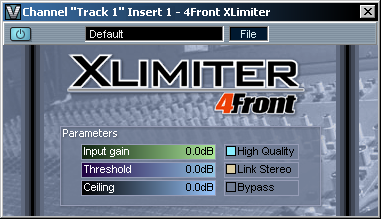 |
||
|
4FRONT AUXITER (VST/DX)
This is a high frequency refresher exciter-type plugin. It brings clarity to the high end by regenerating high frequency harmonics. Primary design goals: - Vocal enhancer - Per/track enhancer - Master track restoration/refreshment - Old tracks restoration Usage: First try to figure right Frequency slider value for your track, then control the Harmonic, Drive and Mix levels to get the best enhancement. 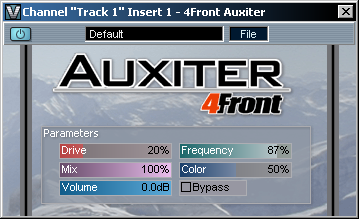 |
||
| 4FRONT SAND BRUSH (VST/DX) The plugin completely regenerates high frequencies, basing on the existing partials. The plugin can be used to apply on hihats and other percussive sounds with high frequency content, and also can be used on other tracks to add "sand". Depending on the settings, plugin can be also used to emulate the vintage vinyl sound. Primary design goals: - Sand for vocal and solo tracks - Bring life back to sampled strings - Track restoration (including MP3) - Vintage effect (to create vintage sound) The plugin contains multiple presets for various track types. 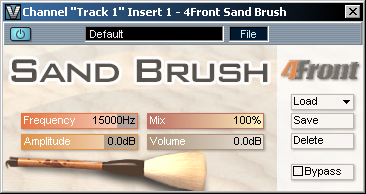 |
||
| 4FRONT CONTOUR MAX (VST/DX) The plugin is designed to change the basic frequency contour of a sound track, or the overall frequency balance of a master. Primary design goals: - Master processing - Per-track processing for balancing low and high end - Track restoration The plugin contains multiple presets for various track types. 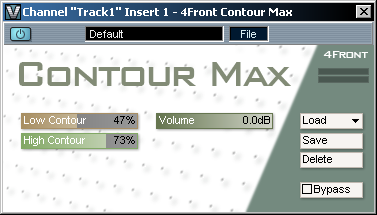 |